science and discovery
A 42-light-year trail reveals how cosmic particles travel
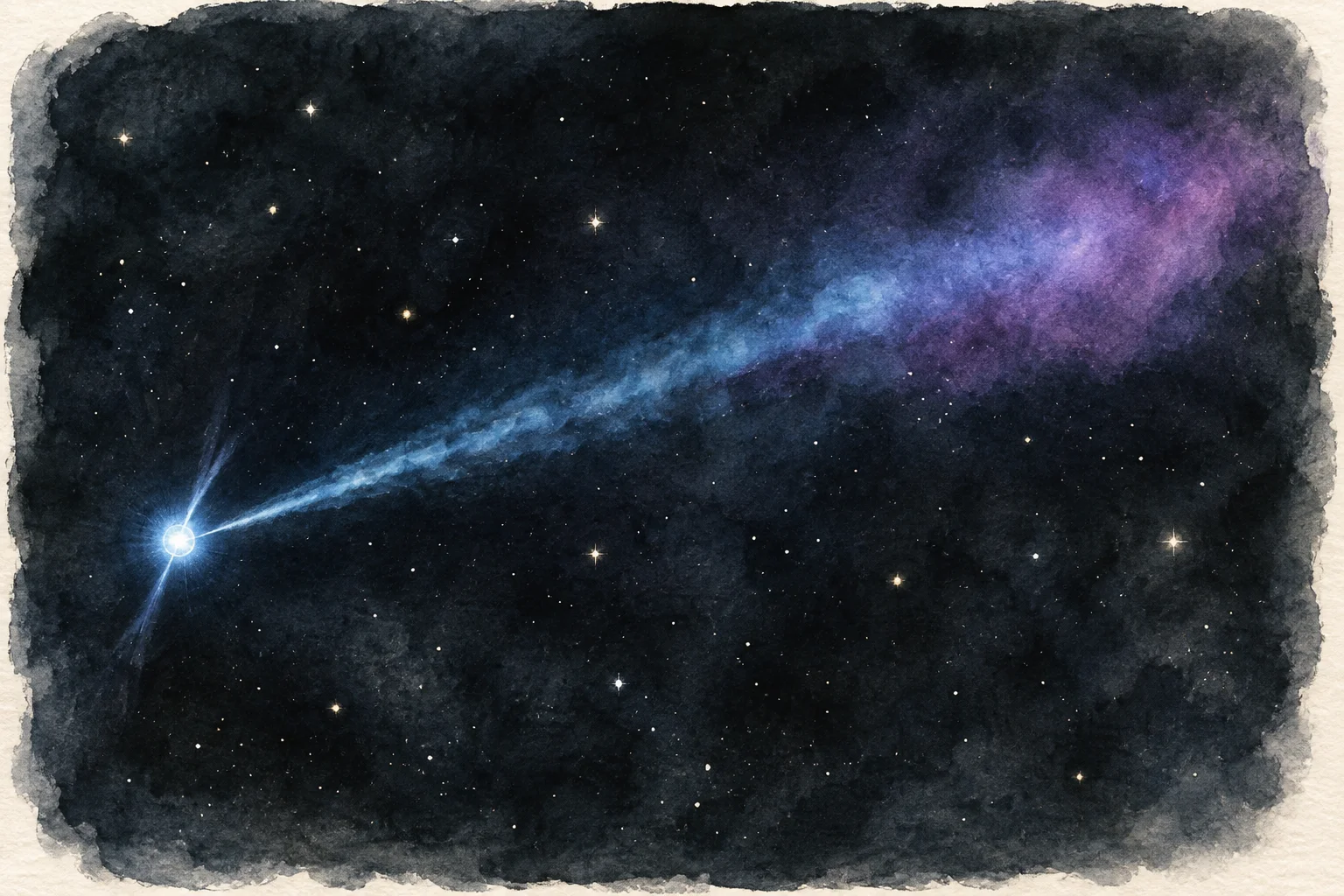
Researchers in China have traced an X-ray trail stretching about 42 light-years through space, showing that high-energy particles can travel long distances in a clear direction rather than immediately scattering in all directions.
The team combined observations of two forms of high-energy light: X-rays recorded by the Tianguan satellite, also known as Einstein Probe, and gamma rays detected by the ground-based LHAASO observatory.
The trail begins near a pulsar about 4,600 light-years from Earth, in a surrounding cloud where particles are accelerated to extreme energies. It is the longest known X-ray tail associated with such a cloud.
Earlier observations had revealed only a few light-years of the trail. After nearly 20 hours of observations, Tianguan uncovered a much longer, fainter structure reaching into the region where LHAASO had detected ultra-high-energy gamma rays. The signals’ locations and radiation properties support the explanation that the same population of high-energy electrons produces both.
That connection lets researchers trace the particles’ journey far beyond their source, challenging the common assumption that they quickly spread out in all directions. Why they retain a clear direction remains uncertain: an ordered magnetic field may guide them, or an outward flow of material may carry them along. Either way, the observations offer new evidence of how energetic particles move through the space between stars.