science and discovery
A lingering cosmic flash points to a collision of dead stars
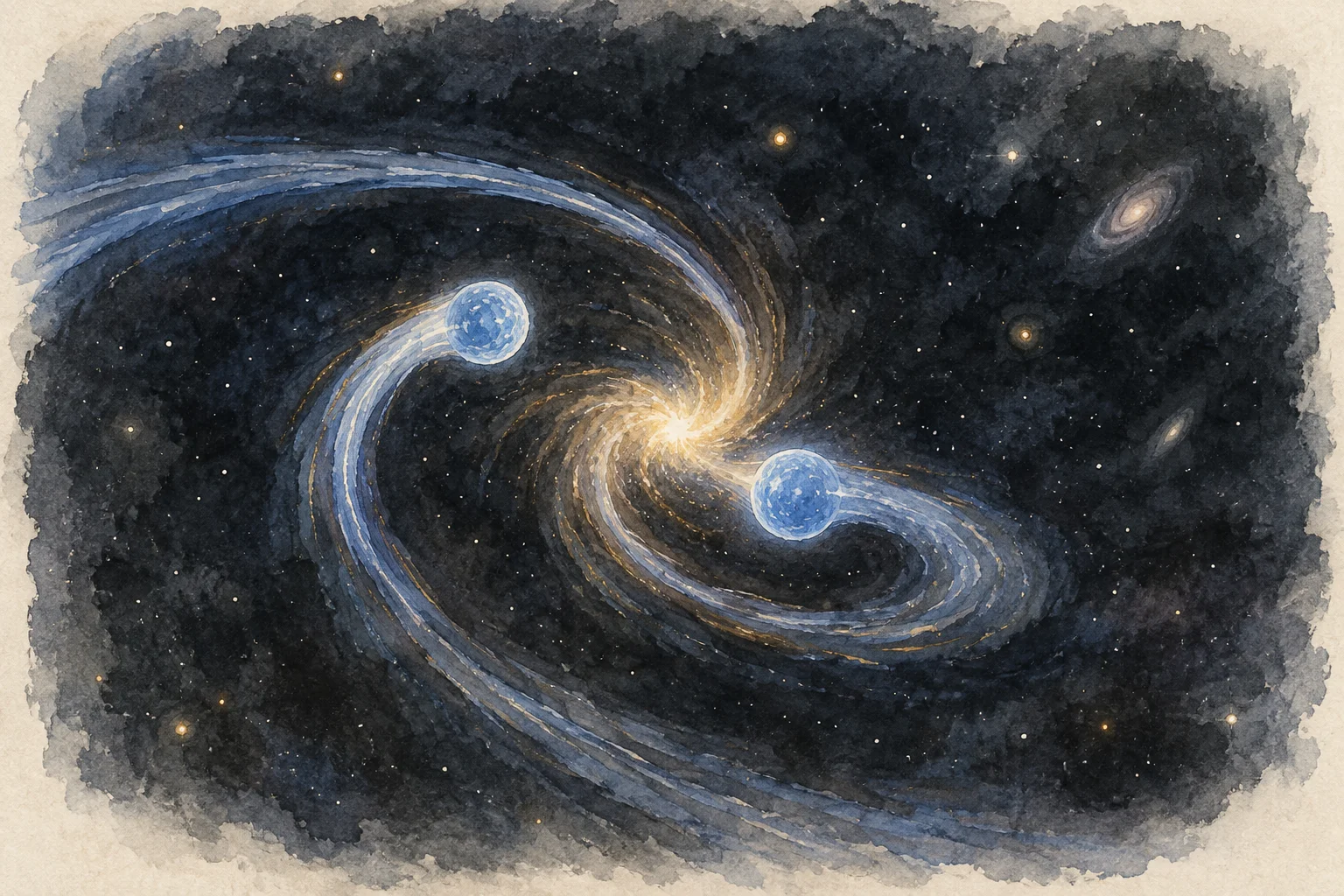
Astronomers have found strong evidence linking a lingering X-ray flash to a collision between two neutron stars, the ultra-dense remains of dead stars. The result offers a clue to the origins of some mysterious flashes seen across the sky.
On 4 July 2025, satellites detected a gamma-ray burst lasting about half a second. The Einstein Probe satellite also caught X-rays from the same event that continued for nearly ten minutes. Its ability to watch a wide area of sky let it capture activity that earlier instruments could have missed.
Follow-up observations with the Very Large Telescope in Chile showed that the light had travelled for more than six billion years. No supernova appeared, helping distinguish the event from the collapse of a massive star. Together with the burst’s properties, that evidence pointed to a stellar collision.
The X-rays varied rapidly and changed in energy, suggesting continued activity at the collision’s centre rather than just a fading glow from its expanding blast wave. One possible explanation is a newborn magnetar: a rapidly spinning neutron star with an exceptionally powerful magnetic field. A black hole could not be fully ruled out.
Published in Science Bulletin, the study suggests similar X-ray signals may accompany other collisions but have gone unseen.