science and discovery
A shared rule may explain when black holes launch jets
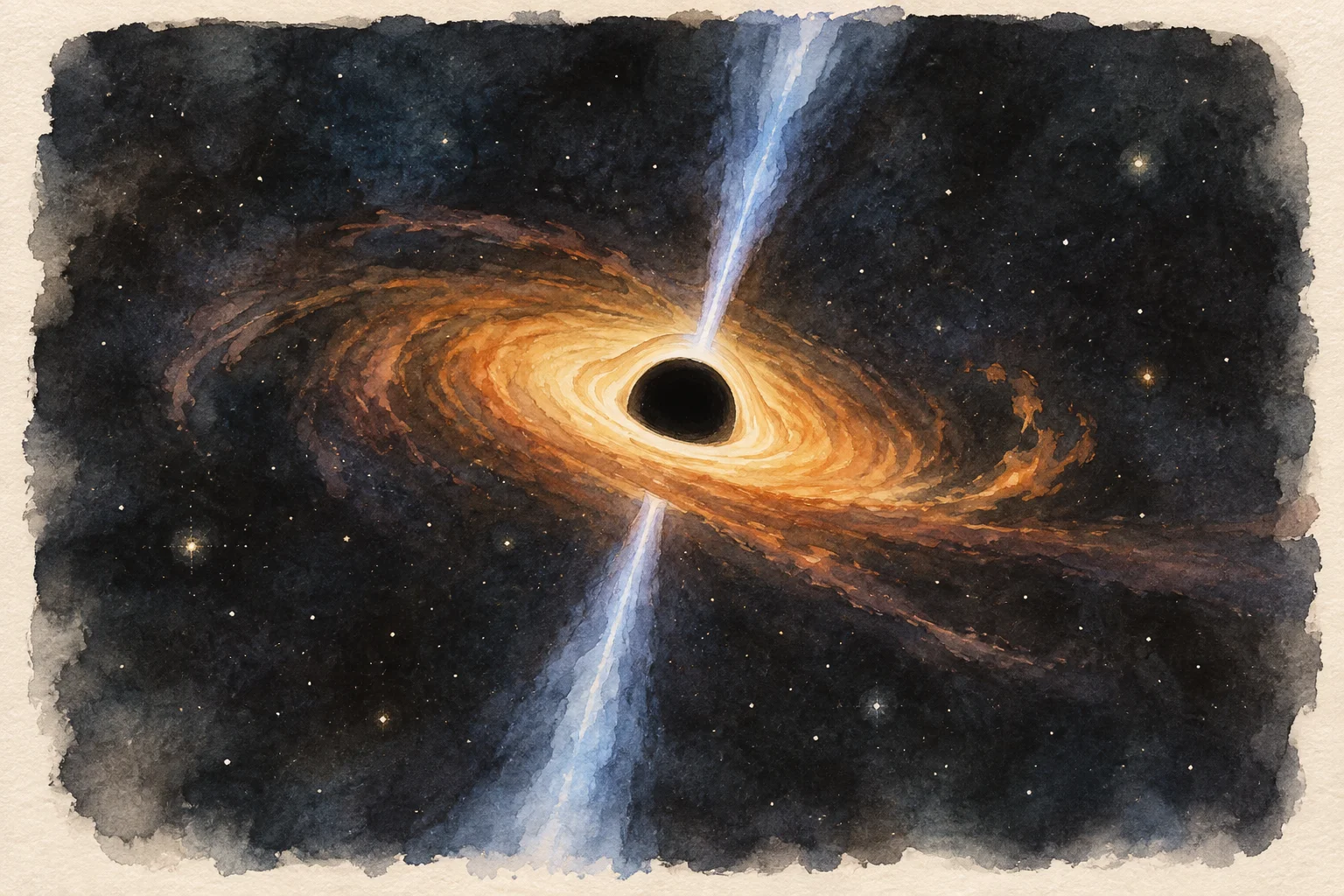
Astronomers have found evidence that supermassive black holes launch powerful jets under conditions also seen in much smaller black holes. The finding could help explain why some outbursts arrive years after a black hole tears apart a star.
The researchers studied events in which stars pass too close to supermassive black holes and are ripped apart by gravity. These encounters provide a rare shortcut: changes that would ordinarily take thousands or millions of years unfold over just a few years as the black hole consumes the debris. The team gathered observations of 20 such events, with 10 providing enough information to reliably compare feeding rates with jet activity.
The analysis identified two phases associated with jets. One comes during the initial feeding rush. The other can occur years later, when the supply of matter has dwindled to about 2% of the Eddington limit. This limit is a benchmark at which outward pressure from radiation can counter gravity’s inward pull. Crucially, a similar threshold is already known in stellar-mass black holes, suggesting that the same underlying physics may govern objects of vastly different sizes.
Published in Nature Astronomy, the study offers a promising way to anticipate these outbursts. If confirmed in more objects, the pattern could help astronomers time telescope observations to catch jets as they emerge.