science and discovery
Astronomers find the Milky Way’s first miniature blazar
Astronomers have identified the first confirmed microblazar in the Milky Way, giving researchers a smaller, closer counterpart to the giant black-hole systems known as blazars.
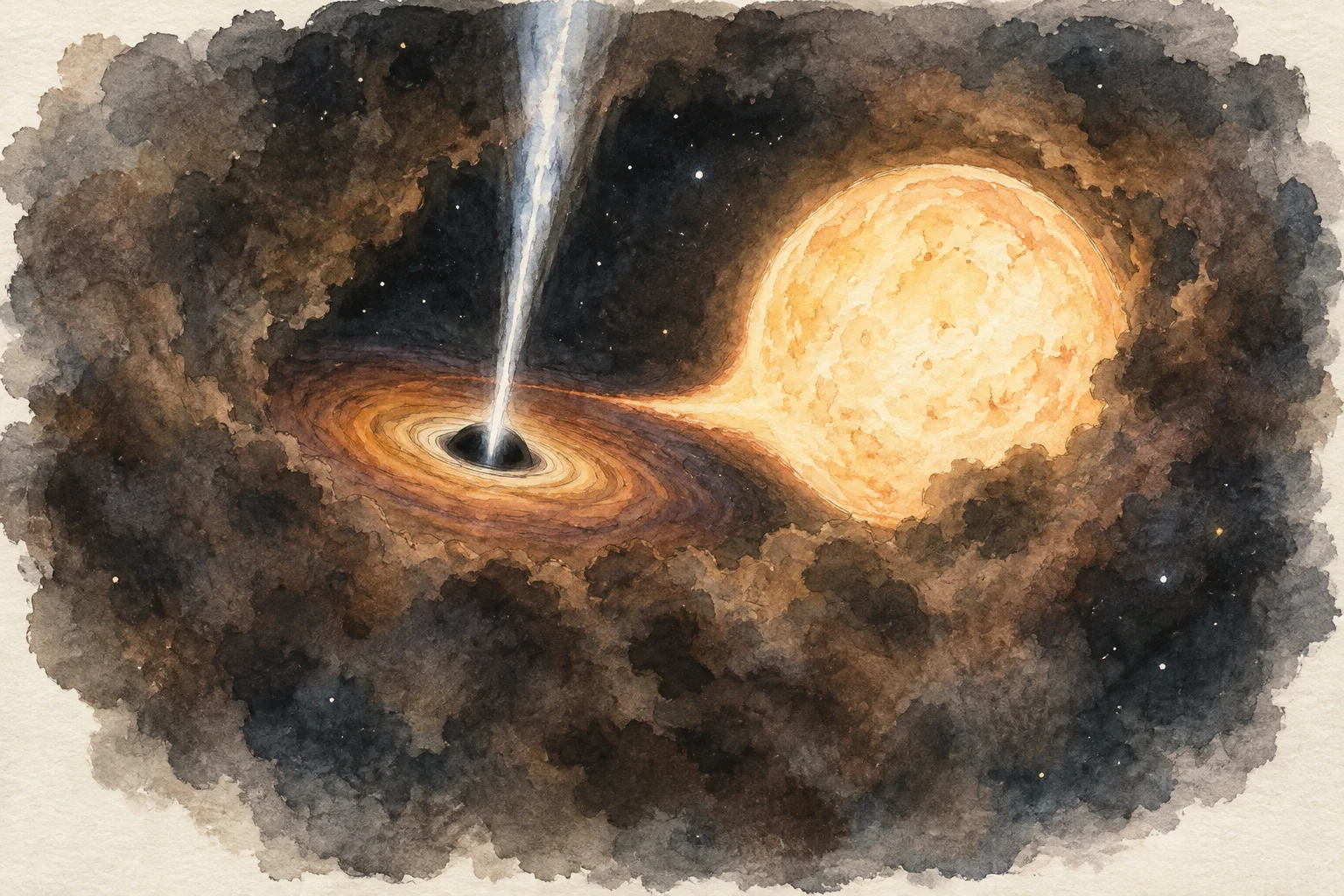
The system, called IRAS 18293-0941, lies about 12,000 light-years away, hidden behind thick interstellar dust. It pairs a hot, massive star with a black hole that orbits it every 11.38 days. As material falls from the star towards the black hole, some is expelled in two opposing jets. One points almost directly towards Earth.
That alignment is what makes it a microblazar. Full-sized blazars are powered by supermassive black holes in distant galactic centres. Astronomers predicted stellar-scale versions three decades ago, but no candidate had previously stood up to detailed scrutiny.
Led by Spain’s University of Jaén, the international team combined measurements of subtle changes in the star’s light with sharp radio images. The observations revealed the system’s orientation and confirmed that the jet belonged to it, rather than an unrelated galaxy behind it. The findings were published in Astronomy & Astrophysics.
The discovery offers a way to watch changes unfold over days that can take thousands of years in larger blazars. Researchers also suspect the opposite jet’s collision with a gas cloud could help explain ultra-high-energy gamma rays detected in that region, though that connection remains unconfirmed.