Science and discovery
Astronomers trace a brief radio flash across 10 billion years
Astronomers have traced a millisecond flash of radio waves to a tiny galaxy more than 10 billion years in the past. It is the most distant fast radio burst whose host galaxy has been identified.
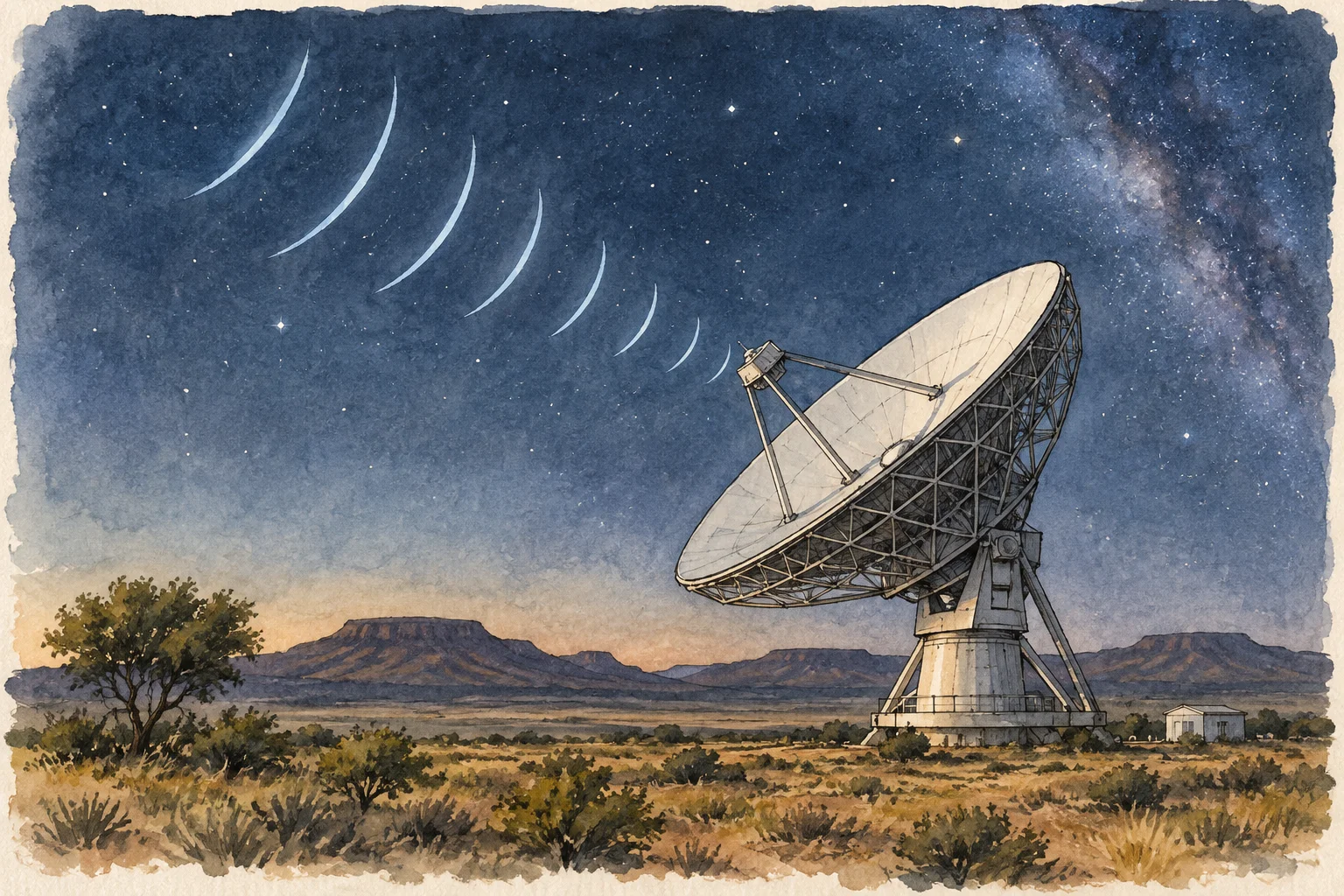
South Africa’s MeerKAT radio telescope detected the signal in 2024, but finding its source required another kind of instrument. Large ground-based telescopes could not see the faint galaxy. The James Webb Space Telescope revealed it, and measurements of its light placed the burst’s origin at a time when the universe was about three billion years old, long before the Sun or Earth existed. The findings are published in Science.
The small galaxy is actively forming stars, offering a clue to what might produce these powerful flashes. Its youth fits one proposed explanation: some bursts may come from magnetars, dense stellar remnants with exceptionally strong magnetic fields. But the cause of this particular burst remains uncertain.
Even without solving that mystery, astronomers can use the signal to study the space it crossed. Electrically charged material delays different radio frequencies by different amounts, revealing how much material the burst encountered along its route.
Finding more bursts at such distances could help researchers map matter that is difficult to observe directly, and understand how its distribution changed as the universe evolved.
Sources
- The GuardianAstronomers detect mysterious burst of energy from a galaxy far, far away
- The ConversationAstronomers pinpoint the origin of a 10 billion-year-old millisecond signal from space
- EurekAlert!Sydney astronomers pinpoint the most distant fast radio burst ever detected
- Australian Broadcasting CorporationIt took 10 billion years for this signal from the early universe to reach us