science and discovery
Early ‘Black Hole Star’ Offers Clue to Webb Telescope’s Mysterious Red Dots
Astronomers have identified MoM-BH*-1 as a compelling example of a “black hole star,” offering a new way to interpret some of the James Webb Space Telescope’s mysterious “little red dots.”
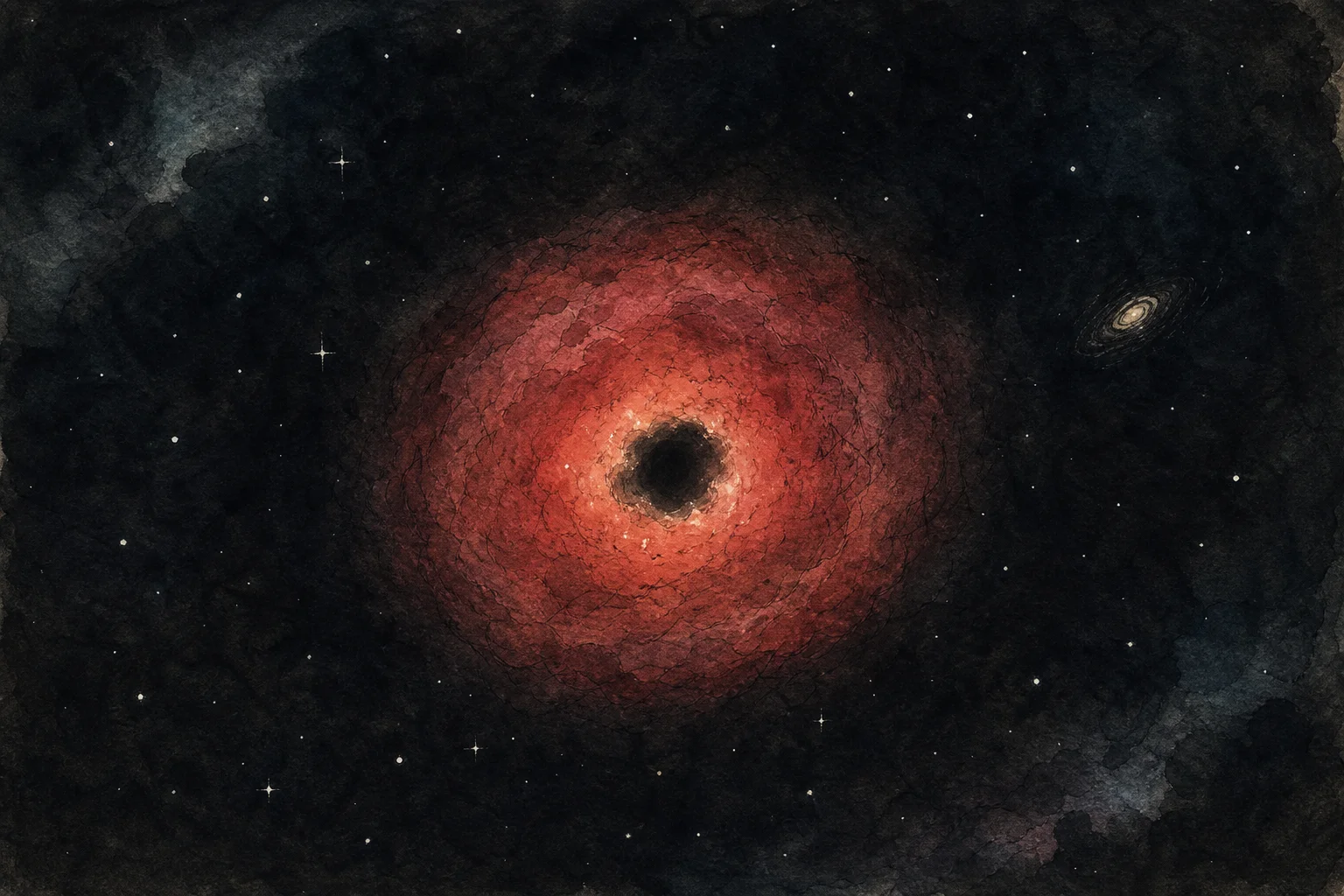
The light now reaching Earth left the object about 13 billion years ago, when the universe was just 660 million years old. Its spectrum combines signatures associated with supermassive black holes and stars, including an exceptionally strong Balmer break. Yet ordinary nuclear fusion cannot account for its enormous output. Modeling instead points to a rapidly feeding black hole wrapped in an extremely dense, turbulent, dust-free shell of hydrogen gas. That gas shifts the emitted light toward red wavelengths while leaving the central source visible.
Crucially, the object appears to outshine almost all of its host galaxy, giving researchers an unusually unobstructed view of the proposed engine. When its spectrum is combined with that of a nearby brighter galaxy, the result closely resembles the puzzling red dots found throughout Webb data.
Published in Nature, the finding remains a model-based interpretation rather than a final answer. But MoM-BH*-1 gives astronomers a concrete spectral template for finding similar objects and testing how black holes reached millions or billions of solar masses surprisingly early.