science and discovery
Gas-shrouded black hole candidate offers clue to rapid early growth
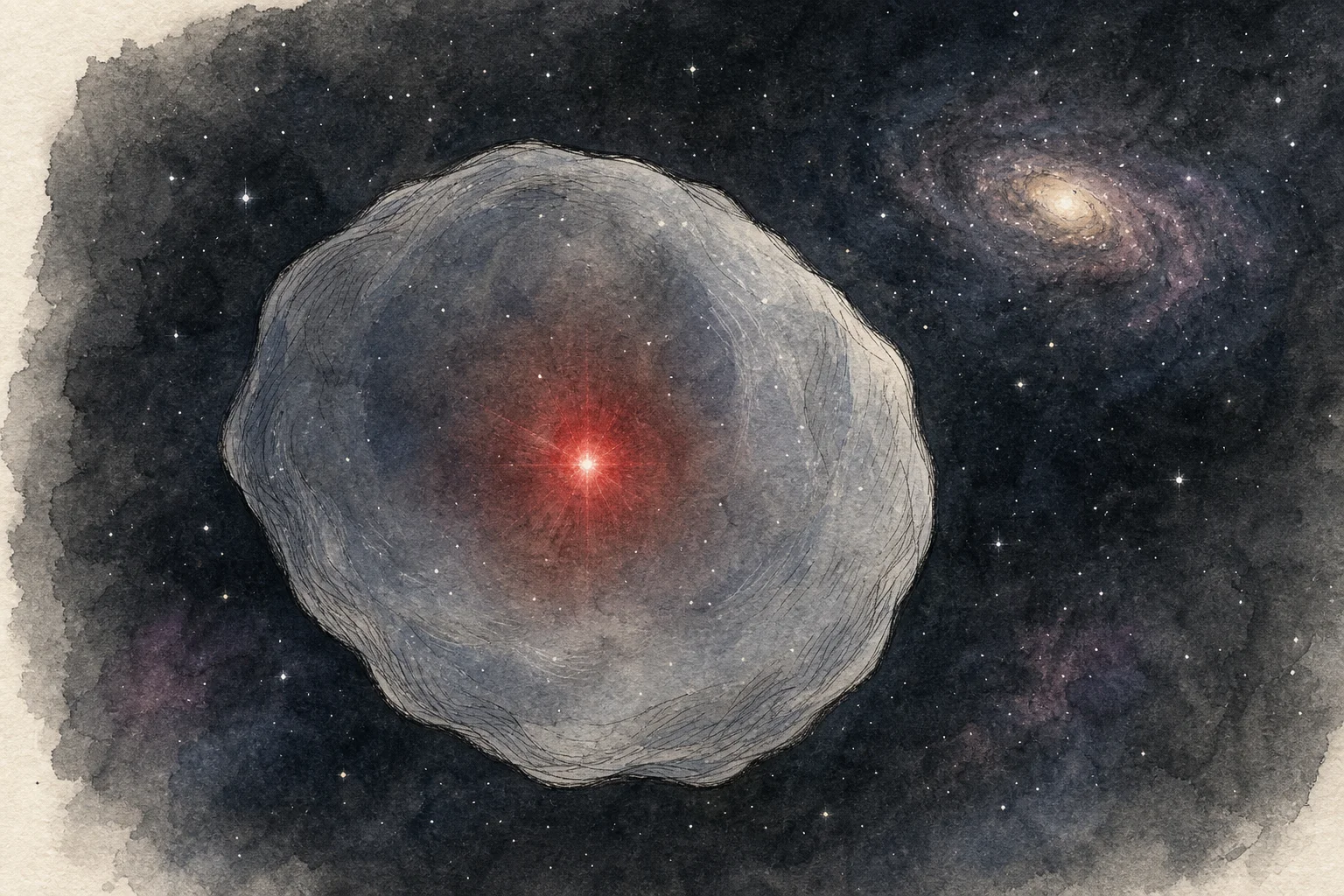
Astronomers using the James Webb Space Telescope have identified a compelling candidate for a “black hole star,” a young black hole enclosed by dense hydrogen gas. Seen as it existed just 660 million years after the Big Bang, the object could offer a physical route for explaining how some black holes reached nearly a billion solar masses before the universe was 700 million years old.
The source appeared as an unusually red point, but spectroscopy showed that ordinary stars and dust were poor explanations. Its brightness drops by more than twentyfold across a particular range of wavelengths, producing a Balmer break measured at 7.7. Even a specially selected population of stars would be expected to remain below about 5. Hydrogen absorption also indicates exceptionally dense gas.
The researchers’ simplified model places a black hole of roughly one million to ten million solar masses inside a nearly dust-free, solar-system-sized gas envelope. Such a cocoon could trap outgoing radiation that would normally slow incoming matter, allowing the black hole to feed faster than its usual limit.
The candidate may also clarify Webb’s puzzling “little red dots.” Here, the black hole and its envelope appear to outshine almost all surrounding stars, offering an unusually clear view of the central engine. Yet the interpretation is not conclusive: the gas geometry and black hole mass remain uncertain, and astronomers need more examples and detailed simulations to test whether this was a common early growth phase.