science and discovery
Scientists create a new form of ice above 2,000°C
Researchers have produced and clearly identified a new crystal structure of superionic ice, an exotic state of water expected deep inside ice-giant planets. The microscopic samples were subjected to pressures of up to 230 gigapascals, about 2.3 million times atmospheric pressure at sea level, and temperatures reaching 2,630 kelvin, or roughly 2,357 °C.
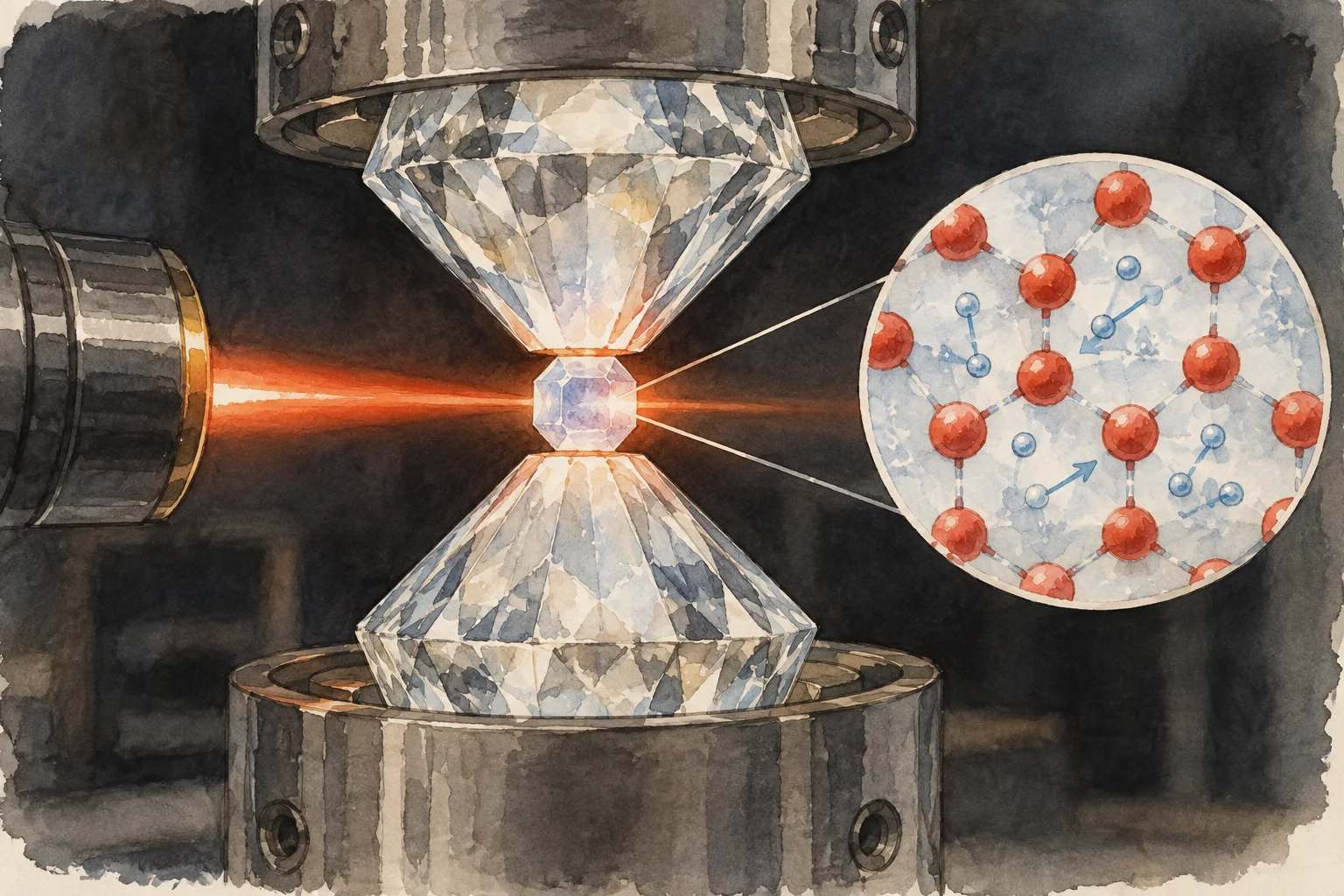
Superionic ice differs sharply from familiar frozen water. Its oxygen atoms form a rigid crystal lattice, while hydrogen nuclei move freely through that framework like particles in a liquid. This combination gives the material both solid and liquid-like properties.
The team compressed water between diamond tips, heated it with lasers and examined its atomic arrangement using a narrow beam of synchrotron X-rays. Above about 200 gigapascals, the oxygen atoms adopted a hexagonal close-packed structure that became dominant over the previously observed face-centred cubic form. The experiments also showed that the two structures can transform into one another as conditions change.
Superionic water is thought to occupy substantial regions inside Uranus and Neptune. Because different crystal structures may have different electrical and mechanical properties, the finding could refine models of how material and charge move inside these planets. Further calculations are still needed to establish how the newly confirmed phase might contribute to their unusually shaped magnetic fields.
Sources
- iXBT.comБолее 2 млн атмосфер и 1500 °C: ученые открыли новую форму горячего льда, который, предположительно, скрыт в недрах Урана и Нептуна
- РБК-УкраинаЛед не тает даже при 2000 °C: физики впервые создали аномальную форму воды
- Корреспондент.netУченые открыли новую форму льда, которая существует при температуре 2000°C
- Yeni Akit GazetesiUzay bilimine ışık tutacak keşif: 2 bin derecede yeni buz türü