Science and discovery
Mars’s giant cloud may form without dust
Scientists have recreated key features of a vast Martian cloud in computer simulations, offering a new explanation for its formation: water vapour may freeze into ice without first gathering on dust.
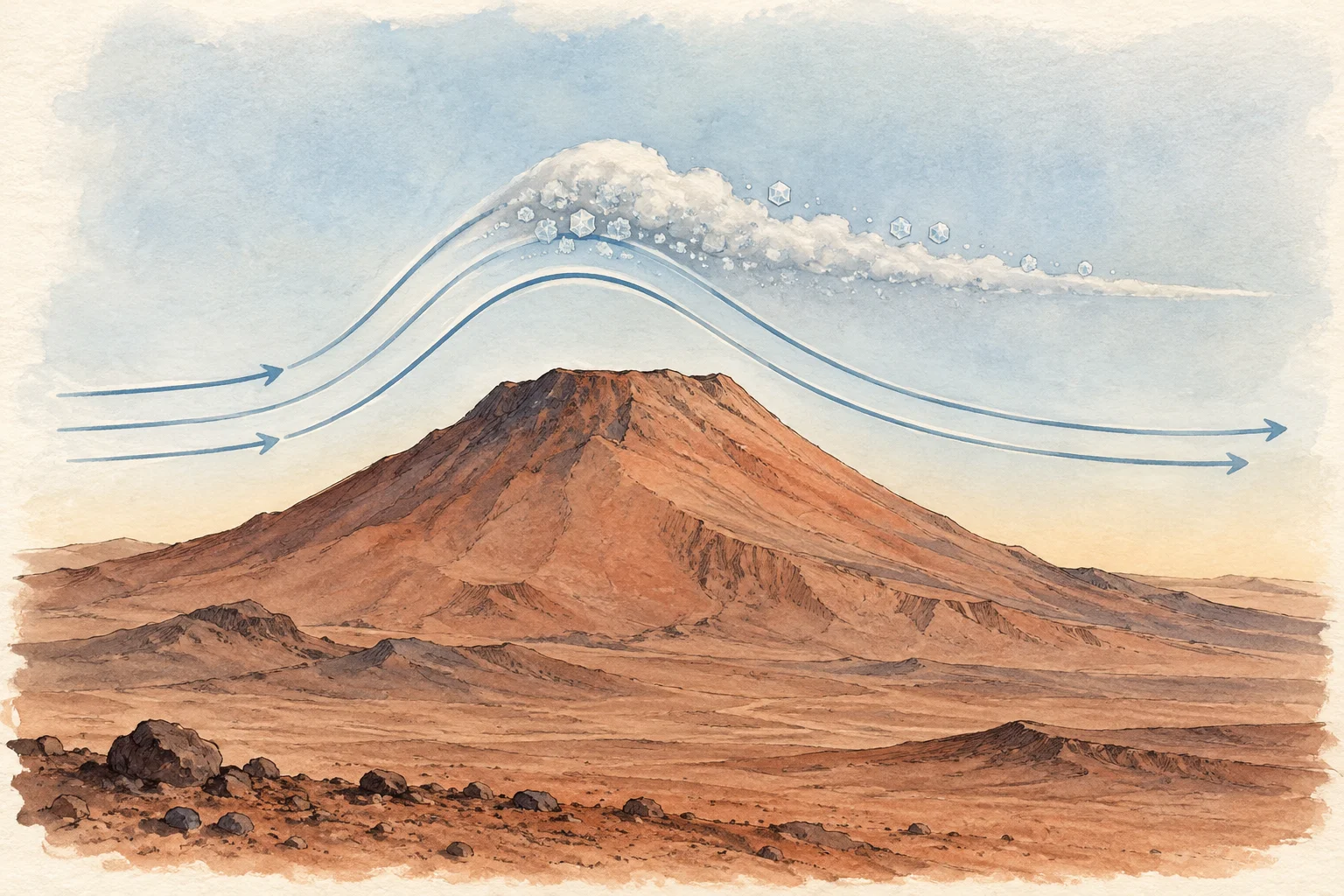
The water-ice cloud stretches up to 1,800 kilometres downwind of the Arsia Mons volcano. It appears each morning during spring and summer in Mars’s southern hemisphere, then fades, repeating the cycle for months.
For the study, published in Nature Geoscience, researchers used images from the European Space Agency’s Mars Express spacecraft to guide their modelling. Usually, cloud droplets or ice crystals form with the help of tiny airborne particles. Adding a process that bypasses those particles allowed the team’s model to reproduce the cloud much more closely.
In the model, winds passing the volcano trigger a powerful wave that lifts moist air several kilometres in minutes. The rapid cooling creates conditions in which water vapour can freeze directly into ice particles.
The model does not match every detail, and confirming the explanation will require further observations. For now, it offers a promising answer to a puzzle that earlier simulations could not resolve.