science and discovery
Orbital tracking detects a deep hemispheric divide inside Mars
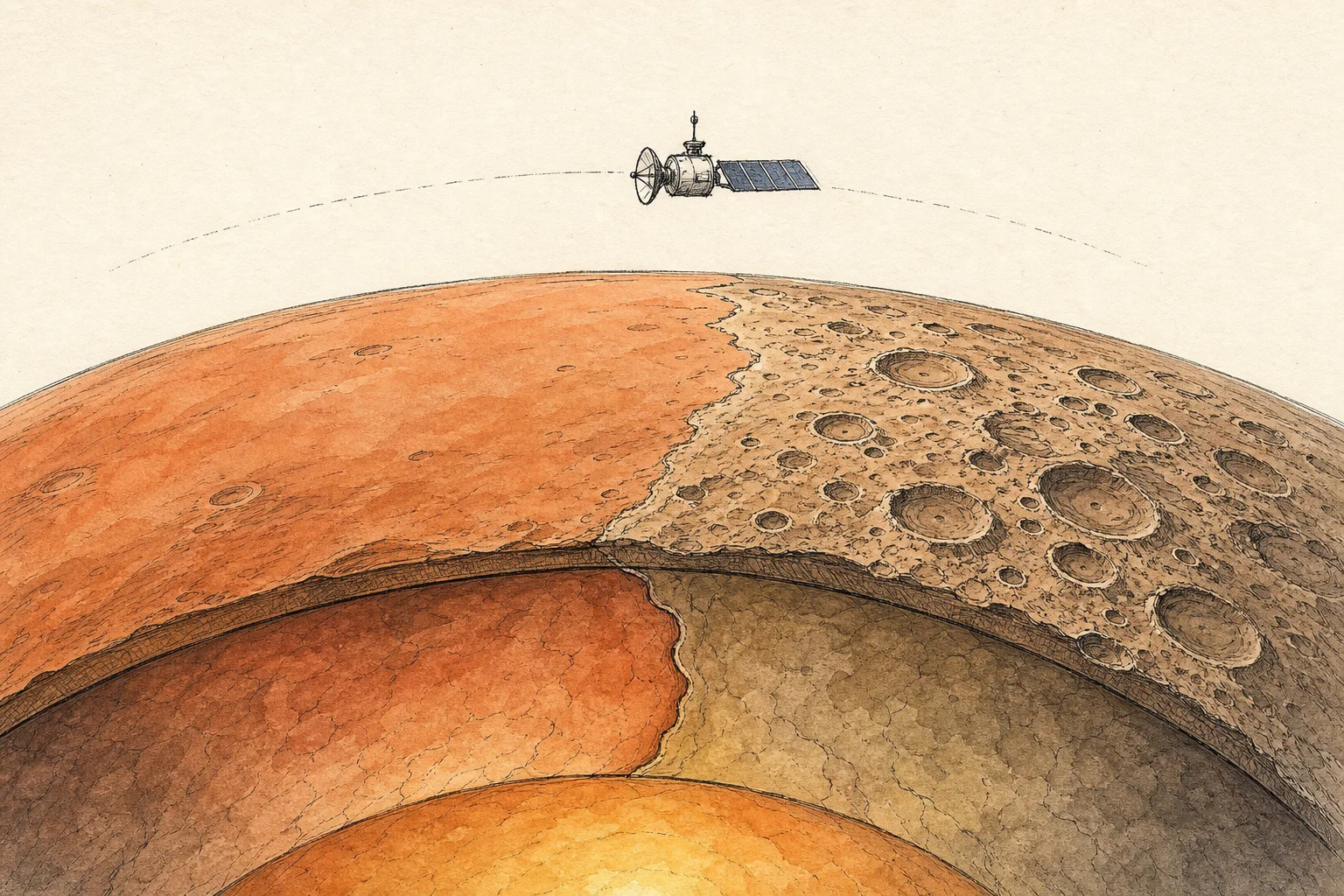
Researchers have used 16 years of spacecraft tracking to detect a planet-scale asymmetry beneath Mars. Reported in Nature, the work applies tidal tomography to the Red Planet for the first time and suggests its contrasting northern and southern landscapes reflect differences extending more than 1,000 kilometres into the mantle.
Mars’s eccentric orbit and tilted axis cause the Sun’s changing gravitational pull to flex the planet slightly during its 687-day year. By analysing radio-tracking data from Mars Global Surveyor, Mars Odyssey and Mars Reconnaissance Orbiter, the team isolated subtle gravity shifts that altered the spacecrafts’ paths. The measured response departed from predictions for a symmetrical Mars by as much as 300 percent.
Models based on those observations indicate that mantle stiffness differs by more than 20 percent between hemispheres. The softer southern mantle may be 200 to 400 degrees Celsius hotter than the mantle beneath the northern plains. Remarkably, the modeled underground boundary follows the planet’s surface divide, where rugged southern highlands meet smoother northern lowlands and the crust differs in average thickness by about 25 kilometres.
The thermal explanation remains model-dependent and does not demonstrate a continuous layer of molten rock. Measurements from multiple surface locations would help test it. Possible causes include an ancient impact, mantle convection and the thicker southern crust trapping internal heat.