science and discovery
Quantum free-fall test supports Einstein’s core gravity principle
Scientists have observed a long-predicted effect of gravity on a quantum object in free fall, finding that its behavior matched Einstein’s equivalence principle in the regime tested. The study, published in Science Advances, provides an experimental link between quantum mechanics, which describes atoms and other tiny systems, and general relativity, which explains gravity and how objects fall.
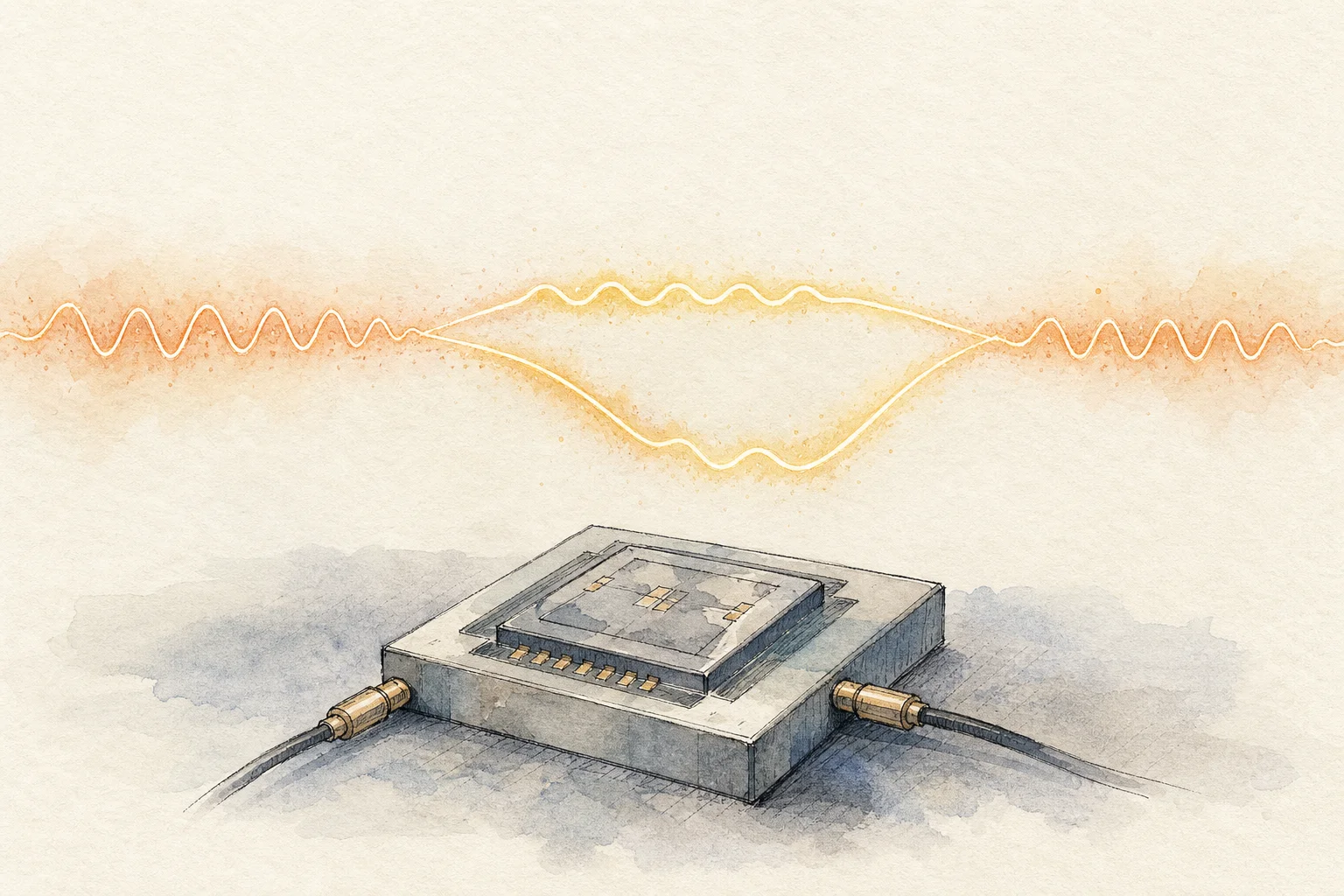
The team worked with clouds of rubidium atoms chilled to just above absolute zero and controlled near a specially designed atomic chip. In a device called the Galileo Quantum Interferometer, each atom’s wave was effectively divided between two paths. One remained fixed relative to the laboratory, while the other was pushed upward, placed in a state barely affected by the magnetic field, and allowed to fall under gravity.
When the paths were reunited, they interfered. This let the researchers measure a minute difference in the quantum phase built up while one part fell and the other stayed still. The measured shift matched the prediction obtained by applying the equivalence principle to such a quantum wave.
That principle says gravity should locally disappear for an observer in free fall. It has been tested precisely with larger bodies, but the relationship between gravity and quantum physics remains unresolved. The experiment does not unify the two theories or show that gravity itself is quantum. It demonstrates that, in this carefully tested setting, a core principle of Einstein’s gravity remains consistent with quantum matter.