science and discovery
Vast hydrogen survey offers new clue to slowing star formation
Astronomers have measured how neutral atomic hydrogen evolved over the past 4.5 billion years with new precision, revealing that this important galactic gas reservoir declined far less sharply than star formation itself.
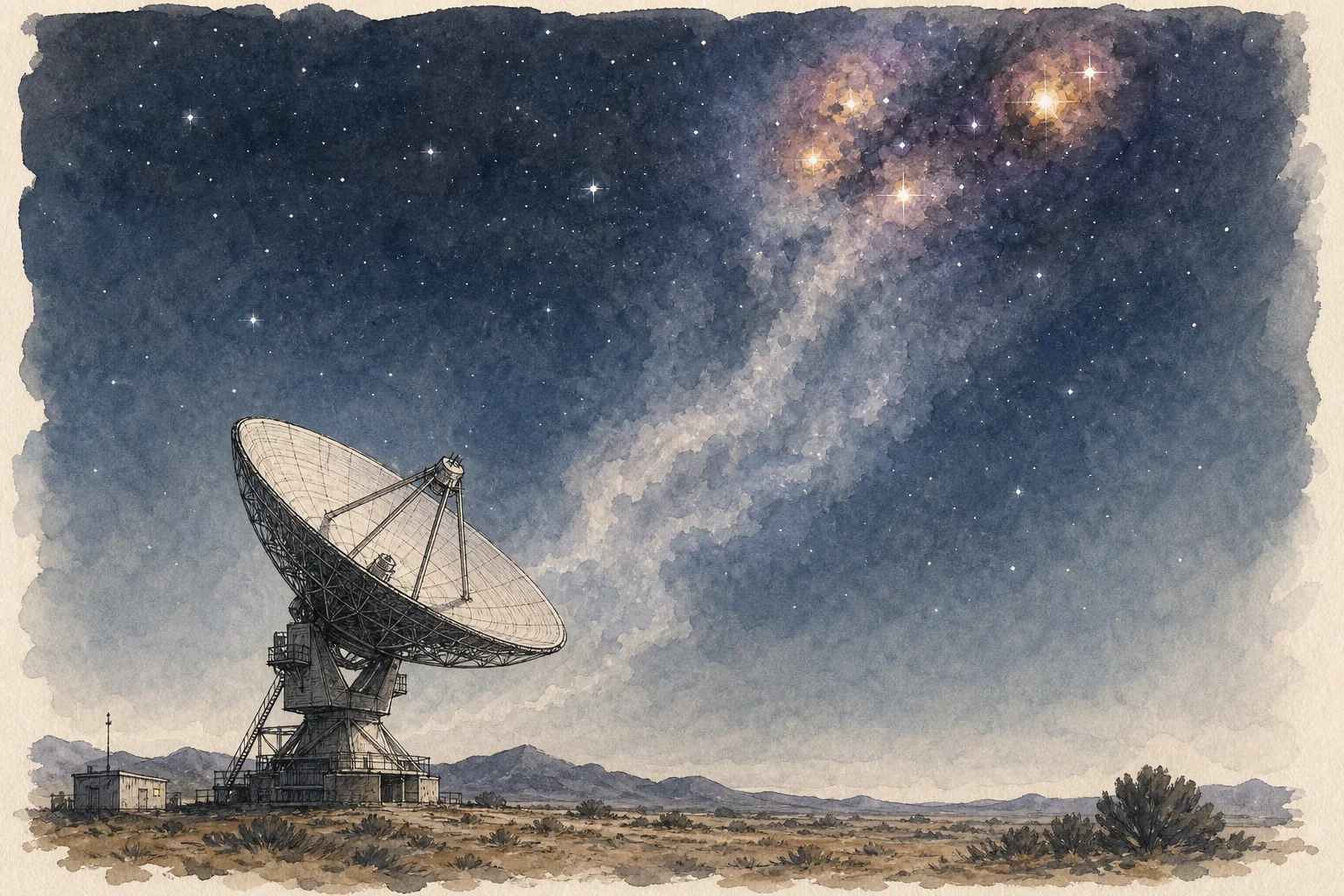
The international team combined observations from the Five-hundred-meter Aperture Spherical Radio Telescope, known as FAST, with galaxy data from the Dark Energy Spectroscopic Instrument. Their analysis covered about 2.5 million galaxies across roughly one-third of the sky. Because the galaxies’ 21-centimetre hydrogen signals were too faint to detect individually, researchers aligned them by redshift, a measure related to distance, and stacked them to extract an average signal from the noise.
The results show that 4.5 billion years ago, the universe’s star-formation rate was about 2.5 times today’s level, while its neutral hydrogen density was only about 1.4 times higher. That mismatch challenges the simple explanation that stars became scarcer mainly because neutral hydrogen was rapidly exhausted.
Instead, the study points to a possible slowdown in how gas is converted. Stars form in dense molecular clouds, not directly from neutral atomic hydrogen. As large-scale gas supplies weakened and gas became less dense, neutral hydrogen may have converted into molecular hydrogen less efficiently. The findings, published in Nature Astronomy, provide a new observational benchmark for studying how galaxies mature and why the universe gradually produces fewer stars.