science and discovery
Webb reveals hundreds of galaxies missing from an earlier Hubble image
The James Webb Space Telescope has revealed hundreds of distant galaxies absent from a Hubble image released in 2014, alongside remarkably fine details of galaxies from the universe’s youth.
The difference comes partly from Webb’s sensitivity to infrared light. As the universe expands, light from distant galaxies shifts towards these longer wavelengths, making Webb especially well suited to detecting objects that were previously difficult to see.
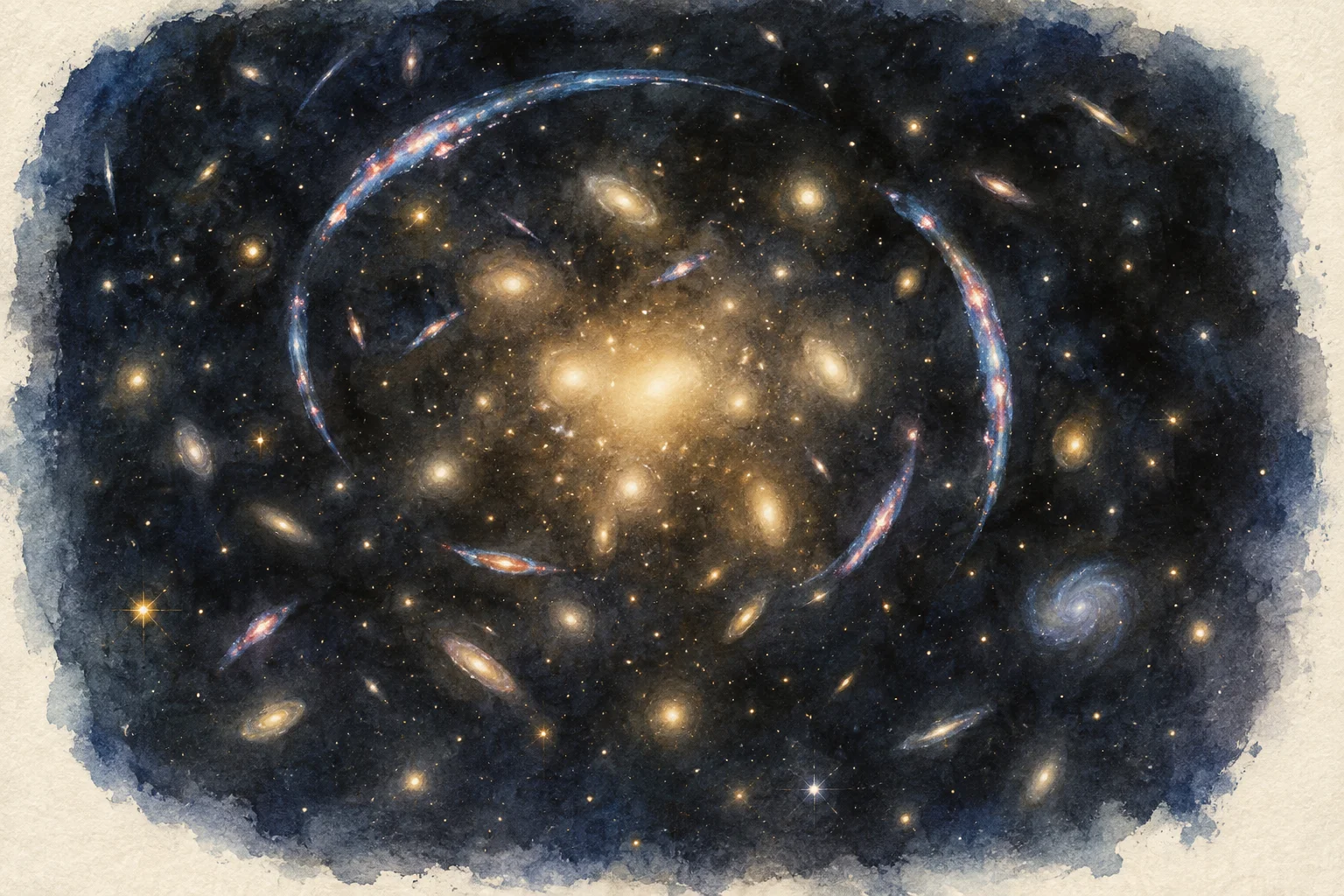
For this view, Webb also has a natural magnifier: the massive galaxy cluster MACS J0454.1-0300. Its gravity bends and magnifies light from galaxies farther away, sometimes stretching their images into arcs or making the same galaxy appear more than once. This effect, called gravitational lensing, brings otherwise inaccessible objects into view.
Among the lensed objects is a group of galaxies seen as they were about 2 billion years after the Big Bang. They appear to be merging, triggering an enormous burst of star formation. Another galaxy is visible as it existed just 800 million years after the Big Bang.
The detail extends to bright, compact regions within the lensed galaxies, some only about five light-years across. In certain cases, these clumps are magnified more than 300 times. Together, Webb and the foreground cluster allow astronomers to examine tiny sites of star formation at distances that would otherwise put them beyond current telescopes’ reach.