science and discovery
Webb Telescope Resolves Earliest Confirmed Close Pair of Feeding Black Holes
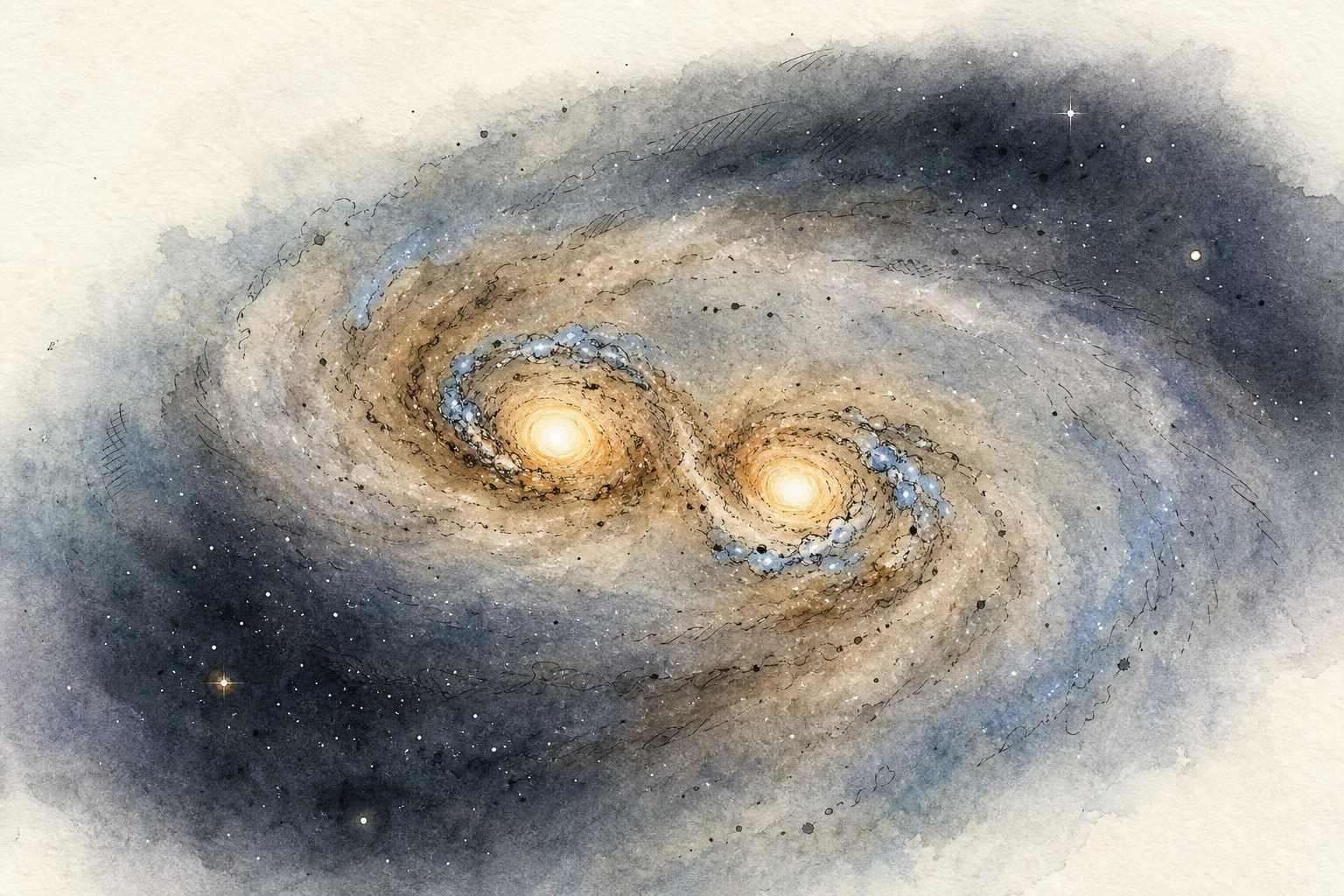
Astronomers have resolved the earliest confirmed close pair of actively feeding supermassive black holes, capturing a stage of galactic growth previously predicted but difficult to observe. The system, known as LID-1166, appears as it was 1.3 billion years after the Big Bang, with its two black holes separated by about 4,900 light-years.
The object first stood out as a strong X-ray source, although it remained hidden in even the deepest Hubble images. The James Webb Space Telescope’s near-infrared spectrograph then distinguished two compact sources. Each showed signatures of fast-moving gas associated with an actively feeding black hole. Observations from the Atacama Large Millimeter/submillimeter Array also found cold gas around both sources, supporting the conclusion that they occupy the centers of two galaxies approaching a merger.
Tests that removed the surrounding galaxy’s light repeatedly preserved the second signal, strengthening the evidence that it is real. More detailed follow-up could further exclude the possibility that residual glow from one black hole mimics another. Earlier candidates from similarly ancient periods have been separated by tens of thousands of light-years, making this pair an unusually close view of the merger process.