Science and discovery
A solar-storm signature turns up near a supermassive black hole
Researchers have detected a pattern familiar from solar flares near a supermassive black hole, providing new evidence that the same magnetic process can power eruptions in vastly different parts of the universe.
The team, led by scientists at the Technion-Israel Institute of Technology, studied X-rays from the region around the black hole at the centre of galaxy NGC 3783. Their observations came from the XRISM and XMM-Newton space telescopes, and the findings were published in The Astrophysical Journal Letters.
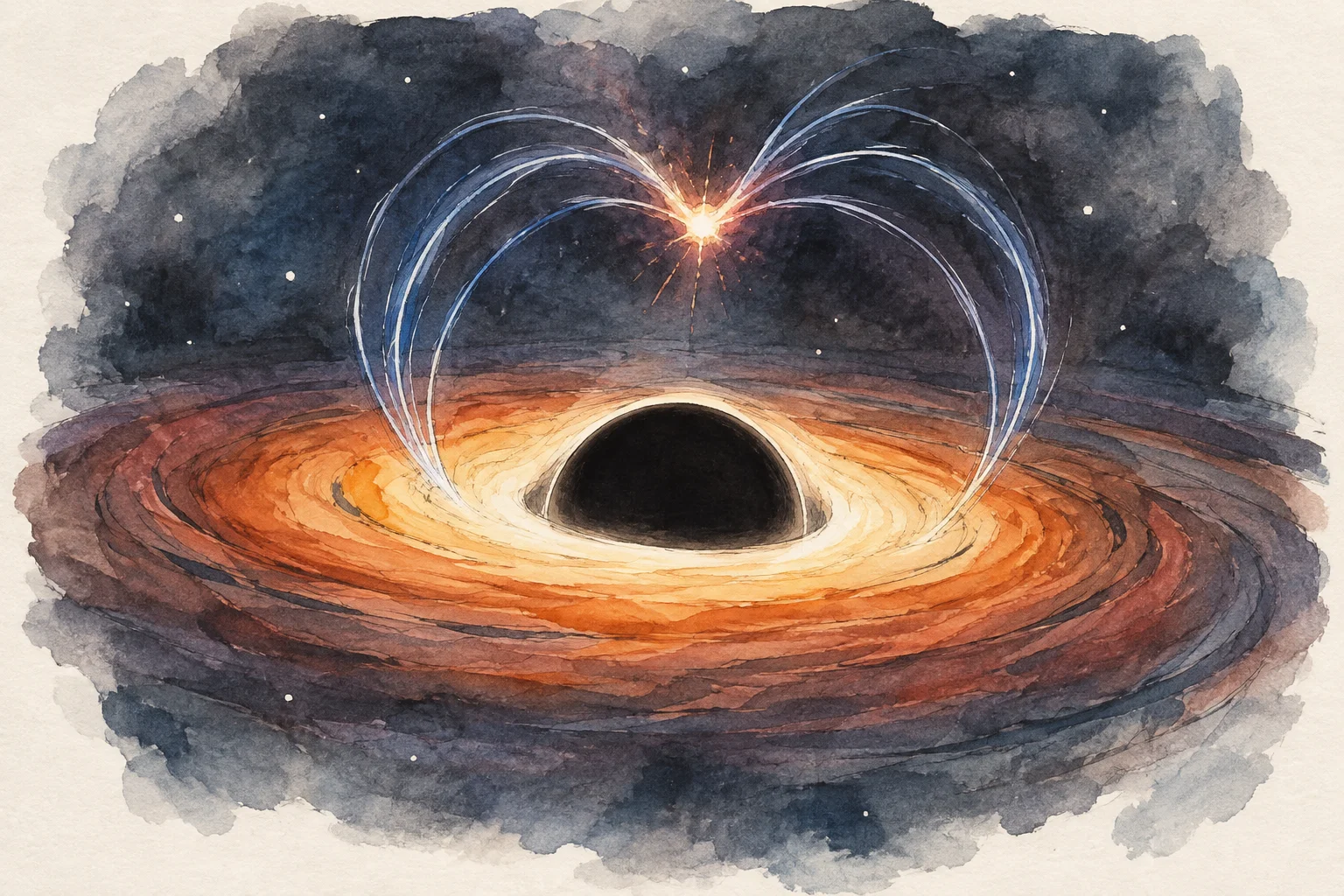
On the Sun, magnetic fields can suddenly rearrange and release stored energy, triggering powerful eruptions. This process, called magnetic reconnection, has also been proposed as an explanation for outbursts in the extremely hot regions surrounding black holes. Until now, observational evidence had been limited.
The key clue was a relationship between different types of X-ray emissions during a flare. Known as the Neupert effect, it was first observed on the Sun in 1968. The researchers report that this is its first detection near a black hole.
They also observed an extremely fast outflow of material, resembling the clouds of charged particles sometimes expelled during solar eruptions. Together, these observations strengthen the case that a process studied close to home also operates around a supermassive black hole, despite enormous differences in scale and conditions.