Science and discovery
Distant atoms reveal a new clue to catalyst design
Researchers in South Korea and Germany have shown that atoms well beyond a molecule’s immediate neighbours can change how tightly it binds to a metal catalyst. The finding gives scientists another factor to consider when designing these materials, which speed up chemical reactions used in industries including fertiliser production.
The team, from South Korea’s Institute for Basic Science and Germany’s Max Planck Institute for Multidisciplinary Sciences, reported its findings in Science.
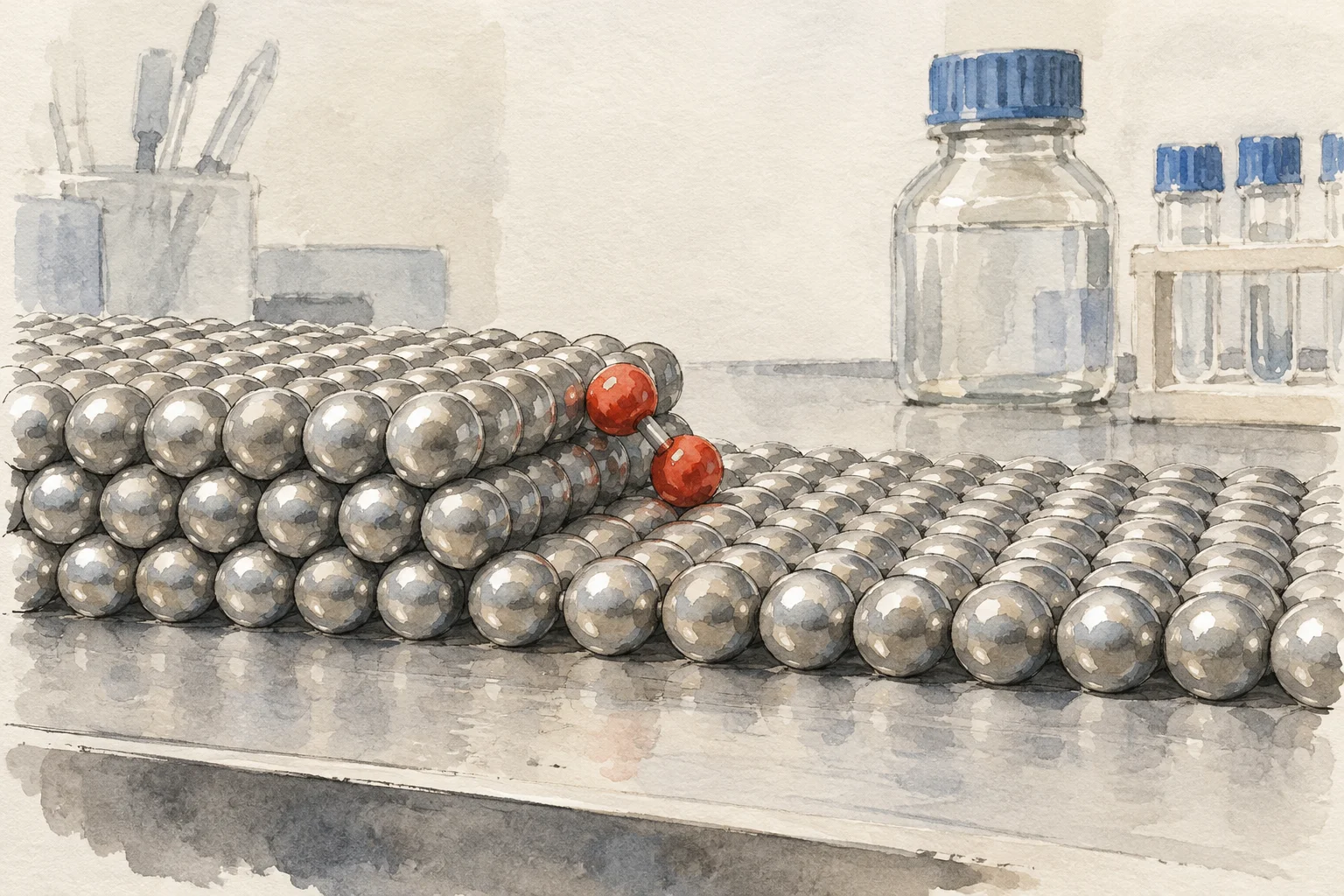
To test how far the influence extended, the researchers made platinum surfaces with tiny, atom-scale steps, varying the spacing between them. They then measured how strongly ammonia, carbon monoxide and nitric oxide molecules bound to those surfaces.
Even when the atoms at the attachment point were arranged similarly, changing the distance to a neighbouring step altered the bond strength. The effect reached across several nanometres. A nanometre is one-billionth of a metre, but this span is enough to accommodate dozens of atoms side by side.
The researchers traced the effect to electrons spread throughout the metal, which allow a molecule to interact with a wider region than its immediate surroundings. They also developed a model combining chemistry and physics to explain why different molecules responded differently.
The work has not yet produced a better-performing catalyst. Instead, it provides a firmer basis for calculations that could help scientists predict useful properties and design catalysts with less trial and error.