Science and discovery
Tiny pores open a new chemical route without precious metals
Researchers in China have demonstrated two reactions that make useful industrial acids without precious-metal catalysts. Instead, a porous crystalline material guides the chemistry, with both reactions running continuously for 750 hours in laboratory tests.
The work, led by Liu Zhongmin’s team at the Chinese Academy of Sciences’ Dalian Institute of Chemical Physics, was published in Nature on 21 October.
The research concerns carbonylation, a process that incorporates carbon monoxide into other molecules. This family of reactions helps make products ranging from solvents to pharmaceutical ingredients. Widely used industrial methods rely on costly metals such as rhodium or iridium, and separating the catalysts from the finished products can be difficult.
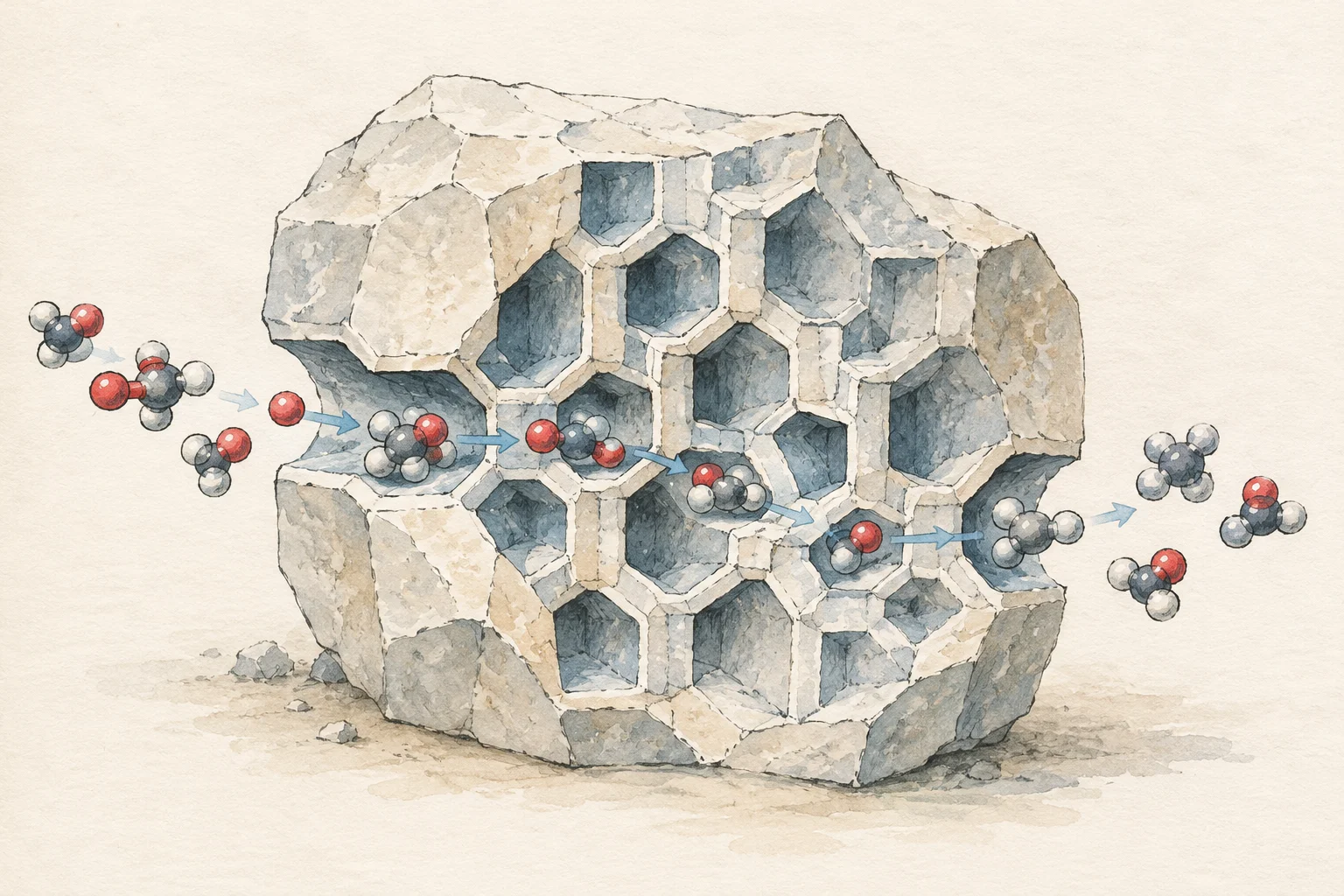
The team used a molecular sieve, a crystal threaded with molecule-sized pores, to make propionic acid and isobutyric acid from ethylene and propylene respectively, using carbon monoxide and water. The pores’ size and location help steer the reactions towards the desired products while suppressing unwanted reactions that can disable the catalyst.
During the high-pressure tests, lasting roughly a month, product selectivity reached about 95% for isobutyric acid and 80% for propionic acid. These figures describe how strongly each reaction favoured the intended chemical, not how much starting material was converted.
The results are promising, but the process is not yet ready for industrial use. The researchers plan to improve its performance and move towards larger-scale tests.