Science and discovery
Astronomers trace a cosmic ‘Treble Clef’ to colliding galaxy clusters
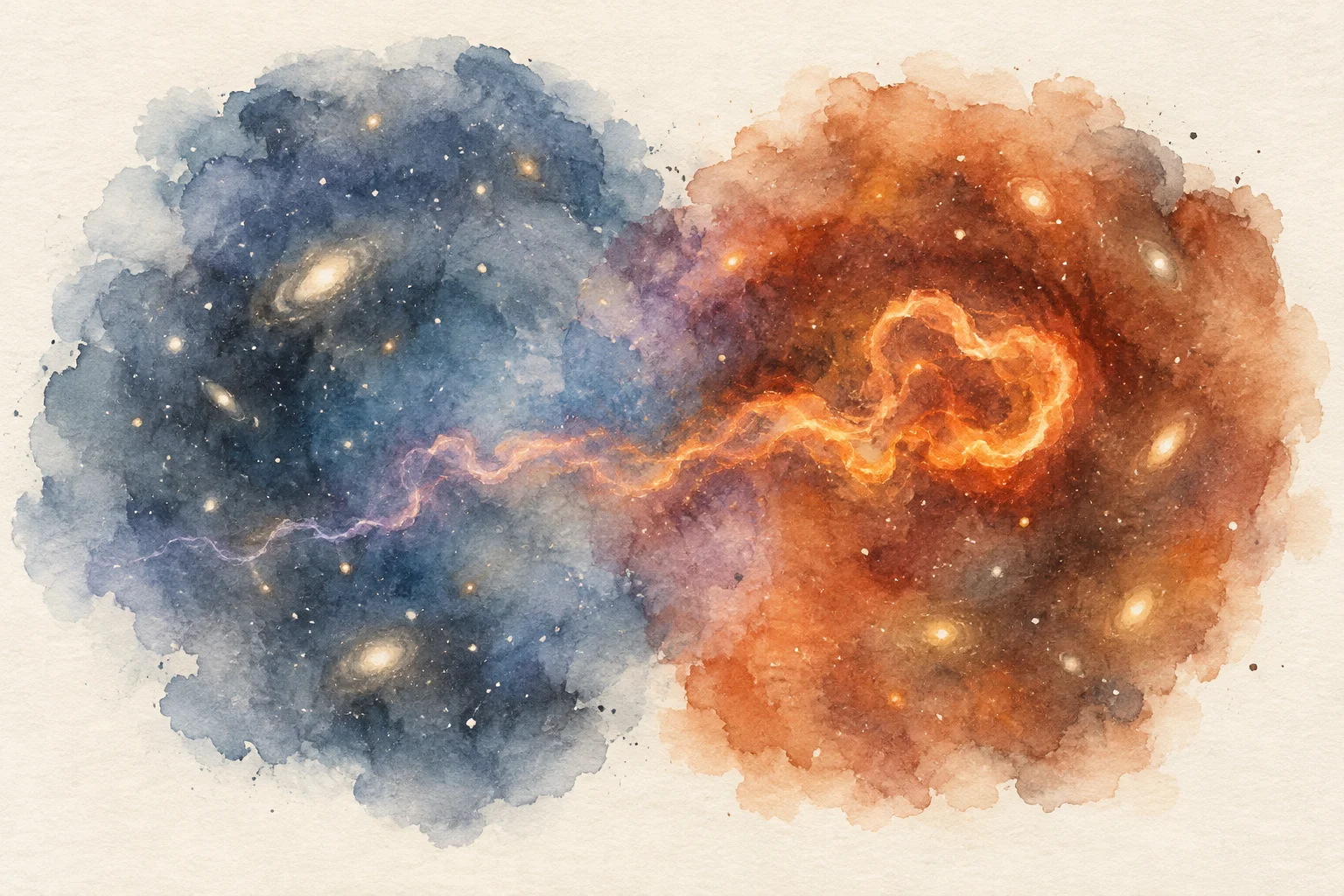
Astronomers have revealed the looping strands of a vast radio source behind the Milky Way and identified its home: two merging galaxy clusters. Nicknamed the “Treble Clef” for its resemblance to the musical symbol, the structure now has a plausible explanation after years of uncertainty.
Foreground stars, gas and dust obscure the region in visible light. But new images from Europe’s Low Frequency Array, or LOFAR, resolved the radio source’s intricate threads. NASA’s Chandra X-ray Observatory and Germany’s eROSITA telescope detected surrounding hot gas, establishing that the object lies within a cluster system about 1.6 billion light-years away and revealing evidence of a collision.
The researchers propose a two-stage origin. First, an outburst from a supermassive black hole sent clouds of energetic particles into the surrounding space. Their radio glow gradually faded as the particles lost energy. Later, the cluster collision may have compressed or reenergized that material, making it shine brightly in radio waves again. Moving gas could have twisted it into the shape now visible.
The findings, published in Astronomy & Astrophysics, show how improved telescopes can turn an indistinct source into a richly detailed object of study. The formation model remains tentative, however: computer simulations are needed to test whether it can explain the remarkable shape.